


(February 2026)
Over the past several decades the worldwide forecasting of volcanic ash has remained essentially the same. Forecasts typically include the expected motion of the ash along with the tops of the ash. A typical forecast will go out for 18 hours with updates every four to six hours depending of the impacts and severity of the eruption.
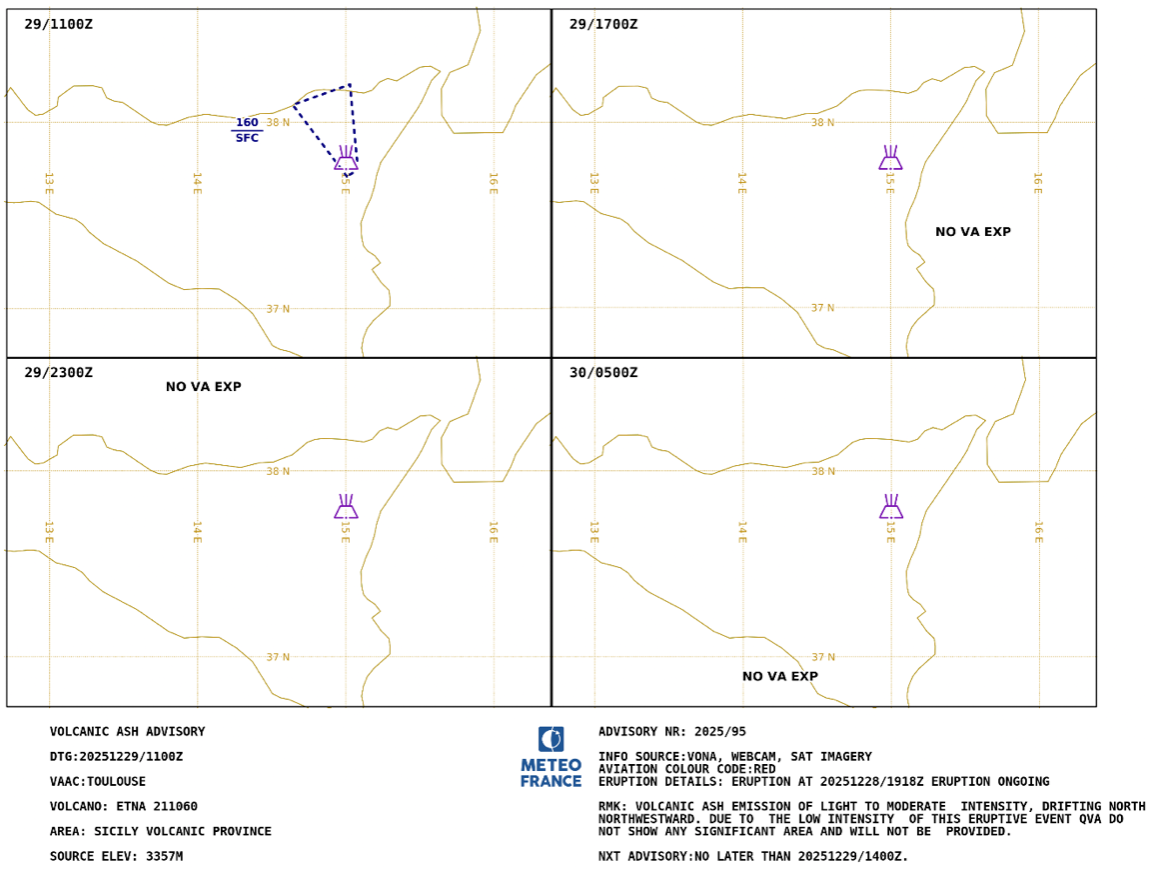
A typical example is from 12/29/2025 when Mt Etna erupted with ash to FL 160.
Last November, a significant change was made to volcanic ash forecasting and this will be available immediately from the Volcanic Ash Advisory Centers in London, England and Toulouse, France. These two forecast offices cover the region from Iceland to Central Russia and India to South Africa. It is anticipated by late 2026 the remaining VAAC’s will implement this new forecasting scheme. The change that has been implemented will be a Quantitative Volcanic Ash forecast (QVA) which provides higher resolution ash location compared to traditional Volcanic Ash Advisory (VAA) products.
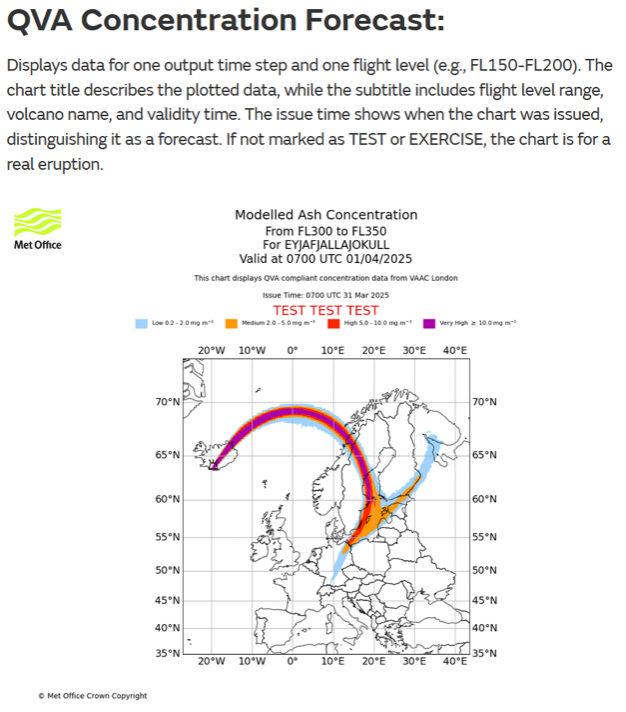
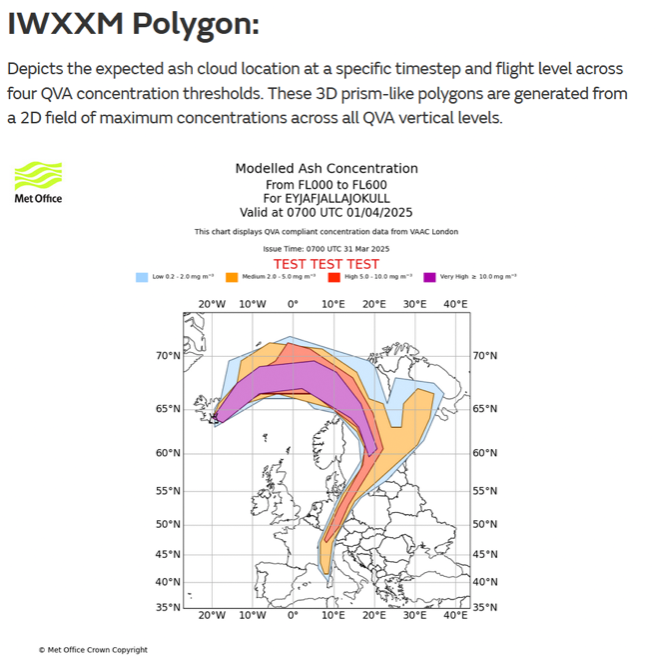
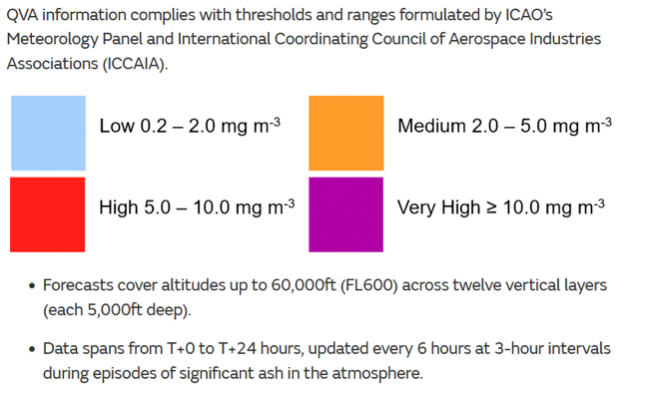
QVA gives you real ash concentration values at different flight levels. Instead of large, shaded areas that simply show where ash might be, you get a detailed 3D picture of how much ash is expected in each place and at each time. This lets operators compare forecast ash directly with engine exposure limits rather than working with broad warning zones.
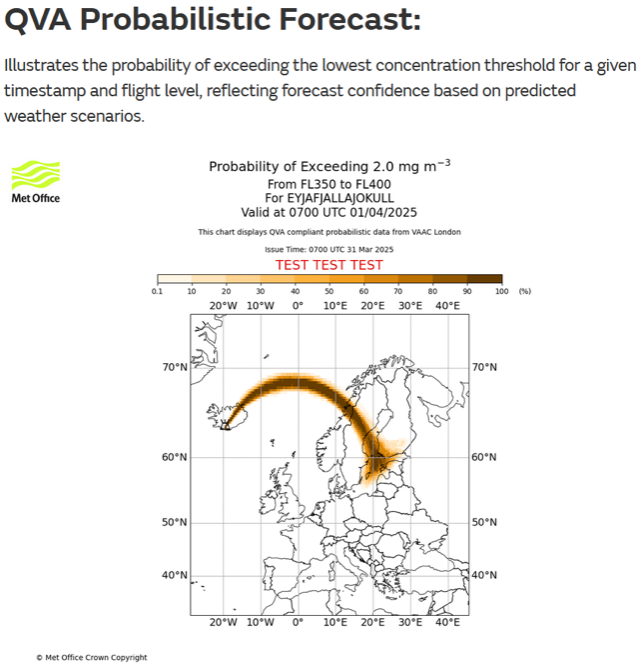
QVA also shows how confident the model is. Low uncertainty means you can keep margins tighter around an ash plume. High uncertainty means planning extra room on the route. It is a smarter and more practical way to think about volcanic ash when planning flights.
A QVA forecast will not be performed if a volcano is of low intensity which happened to be the case on 12/29/2025 with Mt Etna on the island of Sicily.
QVA forecasts will only be provided for “significant eruptions”. For a volcanic ash cloud to be deemed significant and so prompting the provision of QVA a VAAC (Volcanic Ash Advisory Center) will consider the following points.
- Whether the volcanic ash cloud is impacting an international airport or a busy domestic airport.
- Whether the volcanic ash cloud is being transported a long way from the volcano and so impacting air routes.
- Whether there is a user request for QVA issuance.
VAAC London expects to produce QVA forecasts for any eruption occurring on Iceland which is ejecting ash into the atmosphere. Data will be provided by each VAAC via an API, and they will be available from the appropriate volcano ash forecast office, much like they are now.
QVA forecasts will go up to FL 600, at 5,000-foot intervals, out 24 hours at three hourly intervals. New forecast runs will be issued every six hours while a significant ash cloud remains a hazard.
Most importantly QVA looks to be a real upgrade. Flight crews will be able to make smarter and more precise decisions. Low concentrations with low uncertainty may keep your flight close to the optimized route while a high concentration and high uncertainty may result in a reroute.
— — —
To learn more about FPI, FPC, or regarding the Compliance, Operations, Regulatory, and other Special Services Network (SSN) teams, please contact our Operations staff here at Flight Pro International.
Our success is your success! Partner with us today.